I’m scrolling on Instagram as I wait for my online meeting with the curators of the Cinematheque Beirut to begin. In my feed, sandwiched between someone’s photogenic brunch and the images of the first meagre snow in Lithuania, a residential building in the capital of Lebanon is reduced to dust in a matter of seconds. Already taking more than 3000 lives, the ongoing Isreal attack on Lebanon is a spillage of the intensified violence – labelled as genocide by many international organizations – the country has been inflicting on Palestine following the Hamas attack in October last year. The current situation seems like a recurring nightmare in light of Israel’s invasion of Lebanon in 1982, as well as the 34-day July war back in 2006 that equally highlights the struggle both the Lebanese and the Palestinians share.
Today, however, we meet to discuss a different sort of images – for the 5th edition of Vilnius-based video art, artists’ films, and moving image festival Videograms, the Cinematheque has been invited to guest-curate a programme of shorts. Their selection, comprised of four films, takes the quote of author Oxana Timofeeva as its starting point. When asked by an Egyptian journal ‘Mada Masr’ ‘How does one love a homeland without being a fascist and without being a nationalist?’, Timofeeva answers by saying that ‘to love a homeland means to take the risk of telling the truth’. Her answer, which resonates in contexts both local and international, reverberates throughout our conversation as it interrogates missing archives, international solidarity and the purpose of cinema in current times.
‘How are you doing? Is it safe right now?’ I ask Mahdi Awada – the Cinematheque’s preservation and archive coordinator who is also currently pursuing a Master’s degree in Art History and Curation at the American University of Beirut – as I enter the digital meeting room. ‘It is a day-by-day situation’, he answers, then adds ‘There is not only destruction and violence. You also have resistance that’s fighting back’. As we wait for his colleague, a film scholar Anaïs Farine to join, we discuss the tightly-knit art scenes in Vilnius and Beirut, where one cannot help but constantly run into the same set of people. While in terms of size, Vilnius is closer to the Gaza Strip, Beirut is a much smaller city, approximately as the districts of Pilaitė and Fabijoniškės combined. Even so, around 2.5 million people, roughly half of the country’s population, are calling it their home.
Both Mahdi and Anaïs are new additions to the Cinematheques’ team, having joined the initiative a year ago. Its history, alongside the history of its parent organisation The Metropolis Cinema Association, can be best described as a tale of resilience and constant transformation. Officially opened a day before the start of the war in 2006, The Association had to close its doors the following morning and address the need for more independent programming from its cinema hall-turned-shelter. Later, after its 80-seat screening room was exchanged for a bigger venue due to growing demand, the building had to be made vacant because of the financial crisis, forcing the organization to embrace nomadism. Have the current attacks changed much? ‘This summer we moved to a new place (…) We were supposed to have an opening in October but it also didn’t happen. There‘s a recurring postponement of the opening of our Resource Centre’ notes Anaïs.
The Cinematheque project itself was launched in 2018 to preserve the Lebanese film heritage, its ambition lying in the fact that many of those films were lost or destroyed during the Civil War that lasted between 1975 and 1990. When it comes to absence, Mahdi describes their strategy as the fostering of awareness and an activation of dialogue around loss, instead of an attempt to fill in all the gaps. One such example is the series ‘Stories about Lebanese Cinema’, ‘which explored film history in Lebanon through video interviews with prominent characters that have influenced the cinema industry’, highlighting both the ‘surviving heritage, and the voids left behind’. Anaïs continues by sharing another example – Cinematheque’s collaboration with Abboudi Bou Jaoude, a collector of film posters and magazines. Jaoude has ‘dedicated a lot of time to finding posters of lost Lebanese movies in places like Egypt or Syria. Based on these film posters and the information on them he wrote Tonight. Cinema in Lebanon 1929-1979, a book dedicated to the history of Lebanese film’. Even when the actual film copies are missing, such erased histories can be reconstructed by ‘analysing the way the film was programmed at the time, the audience reactions to it if it was recorded in the press or by reading the film critiques’.
Another way the Cinematheque is connecting the past to the present is through its exploration of the broader film culture. I inquire about the event they have organized recently that presented the history of the Arab Film Club in Beirut and the politicization of cinephilia in the 70s – I’m curious whether film culture still has a political dimension in Lebanon today. This is Anaïs’ field of expertise: ‘My understanding of the situation is that the revolution in 2019 and the beginning of the economic crisis that led to the closure of Metropolis cinema, had an impact and changed how films started to be programmed. Previously, you had a lot of film clubs in pubs and schools but after [these events] the culture of watching films and organizing community screenings became political again. The difference between the 70s and the current situation is that previously the clubs were linked to the communist party while the clubs today are not related to any political forces. However, in terms of the programming, one can find overlap, for example, militant cinema from the 70s is still screened in the film clubs today’.
When it comes to political cinema, Lebanon shares a long history with Palestine. In the words of Anaïs ‘In the 80s, a lot of Palestinian films were made by filmmakers or institutions based in Lebanon – for example, the Palestinian Cinematheque that was destroyed and looted [by the Israeli army] in 1982 was operating in Beirut, too’. Continuing such tradition, the film programme Mahdi and Anaïs curated for the festival includes moving-image work by Palestinian filmmakers, too. Since the theme of this year’s Videograms is the ideas of internationalism and international solidarity, our conversation moves on to interrogate what such concepts mean in terms of the ties between Lebanon and Palestine. For Mahdi, it is a rather irrelevant notion, as ‘solidarity often implies standing alongside someone else’s struggle, but in our case, it’s not about support from the outside—we share the same fate and a common enemy. This isn’t merely solidarity; it’s a bond forged in shared blood and sacrifice. We both spill blood, and we both resist. This connection transcends the traditional notion of solidarity because it reflects a unity of struggle, pain, and resistance.’
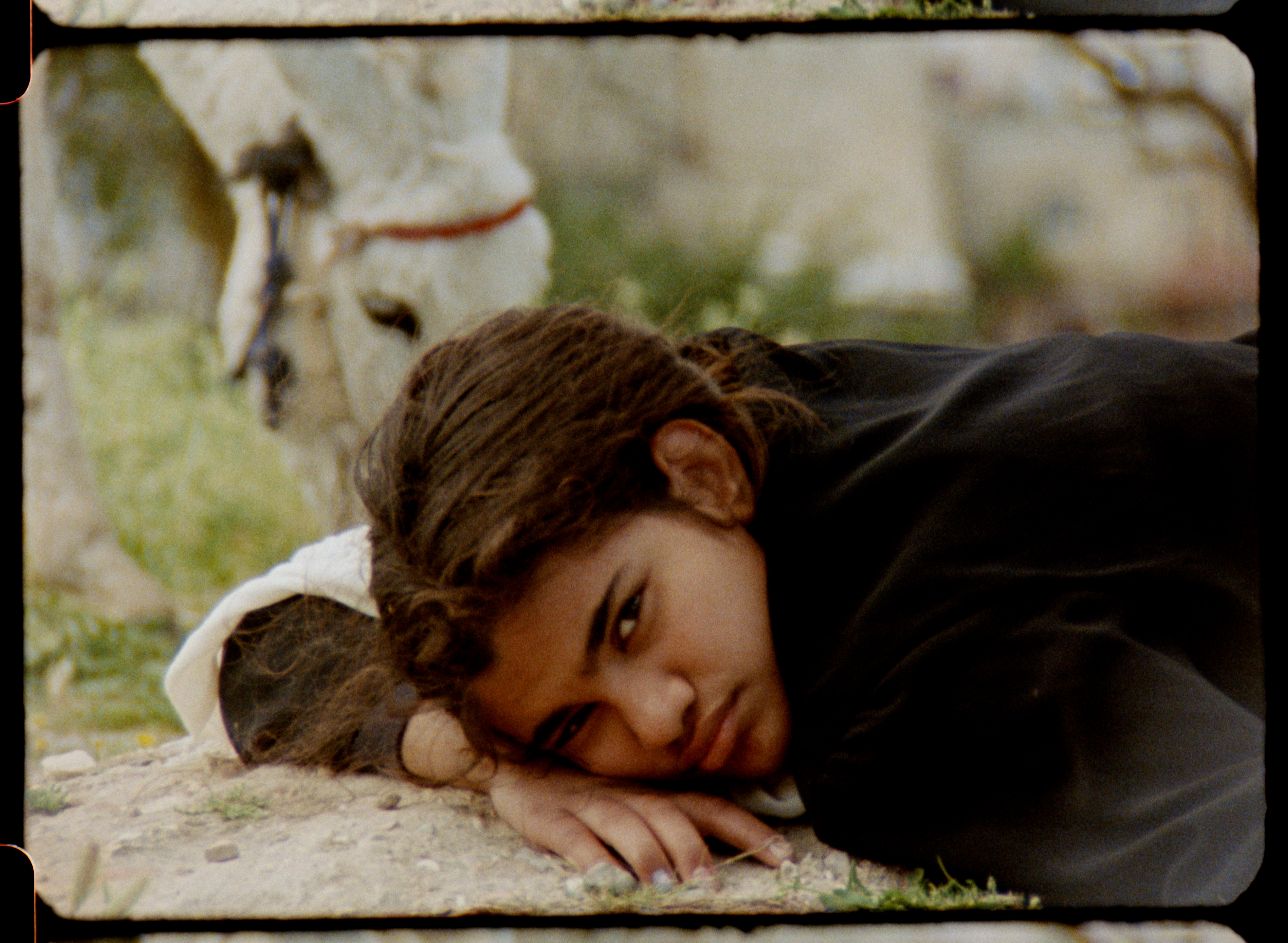
While the programme they curated doesn’t shy away from the grim political realities, it holds space for the poetics, too. This way, creating a different way of engaging with the region that more often than not is portrayed solely as a place of misery by the mainstream media and the cinema industry alike. ‘We started curating this program as the war was escalating in Lebanon. We especially wanted to emphasize the sub-theme of land and ecology.’ says Mahdi. For him, the land is not only a more grounding thread but also a source of unity – ‘I spoke before about the insufficiency of the term solidarity when thinking about the two countries, and we wanted our program to highlight (…) the main protagonist of it all, which is this shared land’. For Anaïs, the programme’s focus also lies at the questioning of the (im)possibility of seeing. Starting from it ‘we move more into the direction of ecosystems and their destruction in times of war or the Israeli occupation in the case of Palestine. Another theme is the embodiment of memory, ways in which memory is inscribed into the land, such as in the film of Noor Abed [‘A Night We Held Between’, 2024, Palestine]’.
In a caption shared on the her Instagram page, Noor Abed dedicates her film ‘To Palestine, to the land of secrets and tales, to all the souls who left us unjustly, to our songs and dances that remain, to hope, to our grieve until the end of times. To the end of occupation‘. It makes me think of cinema as a space for grief in times of conflict, especially in the Palestinian context, where in many cases people are prevented from burying their dead with dignity. Yet, it might also play a role as a way to mourn all the futures that were and continue being lost due to the occupation. The question of the purpose of cinema brings Mahdi to a recent screening of ’R21’ by Mohanad Yaqubi he had helped to organize – ‘The post-screening discussion raised interesting propositions about moving images as [something that is] closer to reality than what’s happening on the ground. It also revealed the troubles regarding the excess of images in times like this.’ ‘When thinking about the present, I recently had a feeling that, personally I am able to describe what’s happening but I’m not able to narrate it’ Anaïs carries on, ‘So I think that in times of war, it is important to watch or to read and to be confronted with reality as it gives us a possibility to narrate our lives’.
For my last question, I ask Mahdi and Anaïs if they, as curators, have hope in change through culture, in cinema as a vehicle for empathy and understanding, especially in a political context such as that of Lithuania. ‘I don’t think it has the power to change any perceptions or opinions’ Anaïs replies, ‘but what a film programme can do right now is to allow people to be together and to continue being together at a time that is very destructive.’ It leaves me wondering if in times when, as Antonio Gramsci puts it, ‘the old world is dying, and the new world struggles to be born’, ‘the time of monsters’, this is already more than enough.


