This year’s festival theme Porosity and the film programmes invites us to explore how we define ourselves and the creation of inner and outer worlds, and discusses the boundaries between them. Videograms 2021 moves from Kaunas to Vilnius, with programming events scattered across November, December and January, different cities and virtual spaces. The first event is the exhibition “Porosity” (curated by Monika Lipšic and Viktorija Šiaulytė) at the cultural venue Sodas2123, open to the public from 18 November to 4 December. The exhibition focuses on the relationship between the living environment/architecture and the inner world of a human/inhabitant.
Later, during thematic screenings at the Skalvija Cinema Center on 8-12 December, the programme What We Left Unfinished (curated by Karolis Žukas) will present archival films by Courtney Stephens, Tomasz Wolski, Mariam Ghani and others, exploring private and public memories. On 15-19 December, a three-part video programme (curated by Gerda Paliušytė) presented in the same cinema space will commemorate the philosophy, work and trajectories of thought of Lauren Berlant (1957-2021). In this programme, the gaze turns to the ability to feel, observe, learn, love, fantasise and desire in a complex world of overlapping artificial realities and regimes – a world that not only limits or disappoints, but also empowers. The programme will showcase a wide range of work by artists and filmmakers representing various generations and a broad geographical spectrum. Featured artists include Myanmar artist Moe Satt, British artist Josiane M.H. Pozi, Indian documentary filmmaker Malati Rao and others. The viewers of the Coming of Age screening will also have the possibility to join the presentation of a new film by artist Daiva Tubutytė, with the participation of the artist herself.

The architecture of the inner world and its accompanying narratives unfold in the three-part programme (curator Gerda Paliušytė) inspired by Lauren Berlant’s (1957-2021) philosophy and trajectories of thought. Berlant paid particular attention to affect, the plane of intimacy and feelings and its relationship to power structures; to that which can smother, or on the contrary – to disrupt repetition and resist control. Berlant was also highly critical of neoliberalism as an all-encompassing, repressive system, encouraging to search for a commonality that enables creativity and allows to reject normativity, preconceived “knowledge” and trivial system-imposed habits. The festival programme is divided into three interconnected parts and keywords: studying-relearning, desire-love and coming of age. The programme focuses on the ability to feel, observe, learn, love, fantasise and desire in a complex world of overlapping artificial realities and regimes – a world that not only empowers, but can also limit or disappoint.

The architecture of the inner world and its accompanying narratives unfold in the three-part programme (curator Gerda Paliušytė) inspired by Lauren Berlant’s (1957-2021) philosophy and trajectories of thought. Berlant paid particular attention to affect, the plane of intimacy and feelings and its relationship to power structures; to that which can smother, or on the contrary – to disrupt repetition and resist control. Berlant was also highly critical of neoliberalism as an all-encompassing, repressive system, encouraging to search for a commonality that enables creativity and allows to reject normativity, preconceived “knowledge” and trivial system-imposed habits. The festival programme is divided into three interconnected parts and keywords: studying-relearning, desire-love and coming of age. The programme focuses on the ability to feel, observe, learn, love, fantasise and desire in a complex world of overlapping artificial realities and regimes – a world that not only empowers, but can also limit or disappoint.

The architecture of the inner world and its accompanying narratives unfold in the three-part programme (curator Gerda Paliušytė) inspired by Lauren Berlant’s (1957-2021) philosophy and trajectories of thought. Berlant paid particular attention to affect, the plane of intimacy and feelings and its relationship to power structures; to that which can smother, or on the contrary – to disrupt repetition and resist control. Berlant was also highly critical of neoliberalism as an all-encompassing, repressive system, encouraging to search for a commonality that enables creativity and allows to reject normativity, preconceived “knowledge” and trivial system-imposed habits. The festival programme is divided into three interconnected parts and keywords: studying-relearning, desire-love and coming of age. The programme focuses on the ability to feel, observe, learn, love, fantasise and desire in a complex world of overlapping artificial realities and regimes – a world that not only empowers, but can also limit or disappoint.
The architecture of the inner world and its accompanying narratives unfold in the three-part programme (curator Gerda Paliušytė) inspired by Lauren Berlant’s (1957-2021) philosophy and trajectories of thought. Berlant paid particular attention to affect, the plane of intimacy and feelings and its relationship to power structures; to that which can smother, or on the contrary – to disrupt repetition and resist control. Berlant was also highly critical of neoliberalism as an all-encompassing, repressive system, encouraging to search for a commonality that enables creativity and allows to reject normativity, preconceived “knowledge” and trivial system-imposed habits. The festival programme is divided into three interconnected parts and keywords: studying-relearning, desire-love and coming of age. The programme focuses on the ability to feel, observe, learn, love, fantasise and desire in a complex world of overlapping artificial realities and regimes – a world that not only empowers, but can also limit or disappoint.

Videograms. Porosity is a video space that reflects on the relationship between architectural forms and inner (human) worlds. Porosity here is a way of measuring the void, the emptiness, both physical and personal; yet it also may denote the permeability of both architectural partitions and social boundaries.
The distinction between public and private worlds is an invention of modernity, when architecture takes on the task of creating the inner world of an individual, which results not only in different typologies of interior spaces, but also in the emergence of a particular “topography” of the inner world. The book Interiors and Interiority (ed. Ewa Lajer-Burcharth and Beate Söntgen; De Gruyter, 2016) draws attention to Walter Benjamin’s take on the subject of the bourgeois class that was emerging at the time and who was the inhabitant of modern architectures: these interior spaces were instrumental in establishing the subject’s relationship with the outside world, withdrawing from it, or gaining control over it. Almost half a century later, the second-wave feminism questioned the naturalised demarcation of the private and the political and claimed that personal is political.
Porosity started by thinking about artistic engagement with the instability of the distinction between inner and outer worlds, seeking to register imprints of the personal on different architectural surfaces. In the exhibition, the works by Sam Williams, Laura Grace Ford, Robin Vanbesien, Shirin Sabahi and Daniel Schwarz open up different perspectives on the subject of porosity in relation to architecture, urban and social structures.
Interior spaces also become the environment for a special relationship between moving images and the viewer which keeps unfolding throughout the pandemic. Without the collectivity of cinema, the consumption of moving images became a very individualised, intimate practice. The “Videograms” duvet cover set displayed in the video room space was developed both as an artist edition and a functional design object as a collaboration by artist Vladas Suncovas, graphic designer Marek Voida and curators Monika Lipšic and Viktorija Šiaulytė. It was conceived precisely as a cover for an individualised consumption of films. At the same time, the print of diagrams on its surface may work like a map of the genealogy of ideas and innovations that represent the desire to be teleported to cinematic, virtual or imaginary worlds.
The pandemic period has also motivated the creation of the website www.videograms.lt together with graphic designer Marek Voida, featuring an Online Room – a space to present artworks in an expanded and discursive format. Anastasia Sosunova’s When all this is over, let’s meet up! (2021, co-produced by Swallow and Videograms) is available on https://videograms.lt as an extension of Porosity.
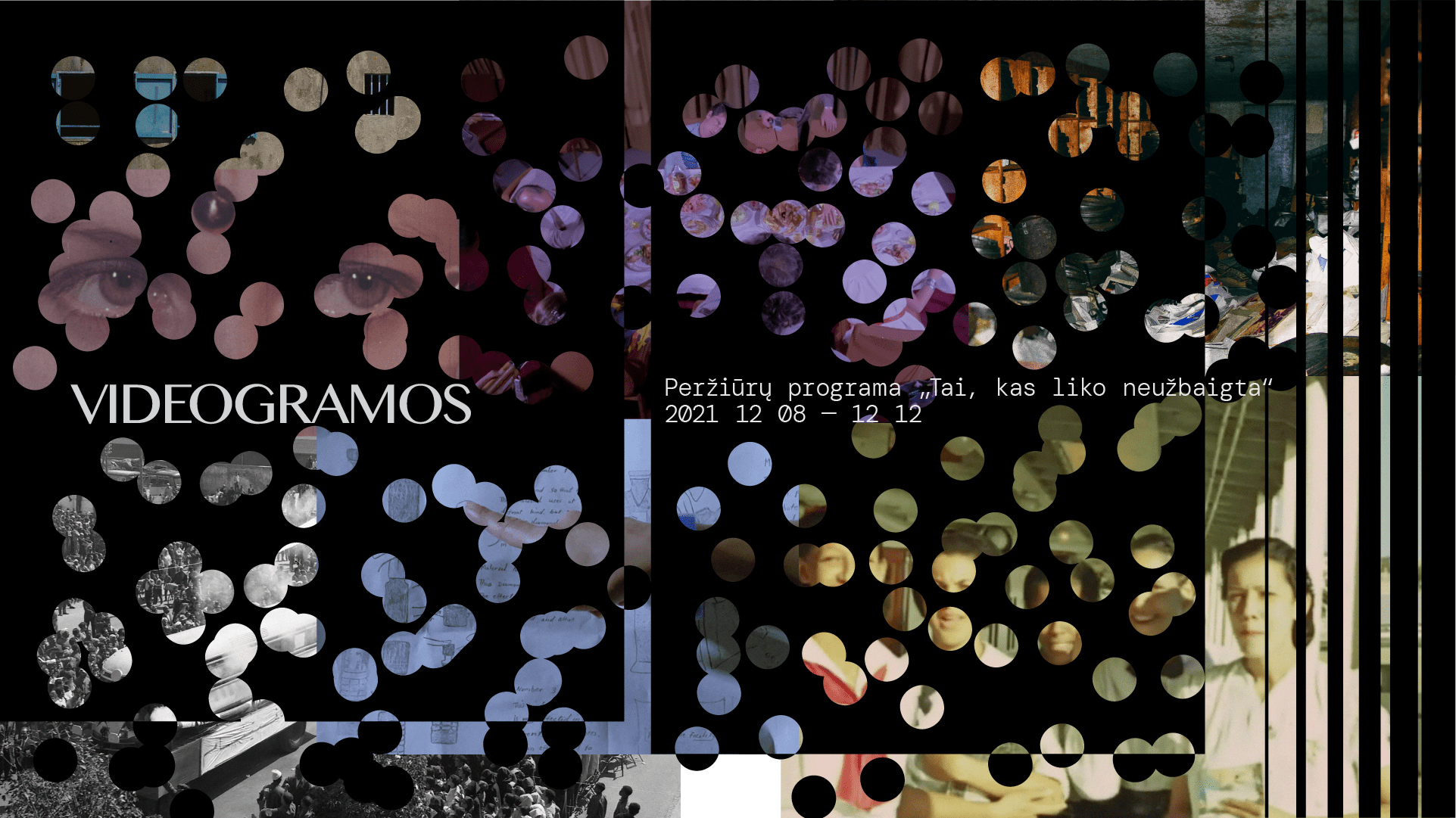
In the What We Left Unfinished programme (curator Karolis Žukas), we will move from private and public spaces to private and public memories. Since the invention of the camera, a vast treasure trove of images has been created in an attempt to represent reality, to narrate our emotions and to create evidence and legacy of public and private history.
By observing archival material, we can grasp how images of the past define our personal and collective memory and how emotional reactions or cultural/gender identities shape our perception of memories. As we are not sure whether what we see in these images is always “reality”, archival filmmaking becomes an attempt to investigate and discover the errors in these images that reflect our world. What comes after is the process of rearranging them, discovering new narratives and finding ways to tell history from our own point of view. It is also a continuation of the humanist tradition, a process of reinterpreting the present, a break in chronology and a time for reflection in order to better understand the present and move forward. The archaeology of images of the past does not only reveal our shared history and societal changes, but also suggests possible trajectories for the future.
Film programme “What We Left Unfinished”
8 December, Wednesday:
5:30 p.m. Film “What We Left Unfinished”
7:10 p.m. Film “An Ordinary Country”
9 December, Thursday:
5:00 p.m. Film “Before the Dying of the Light”
6:40 p.m. Films “Terra Femme” and “All Other Things Equal”
10 December, Friday:
7:50 p.m. Film “An Ordinary Country”
9:00 p.m. Film “War and Peace”
11 December, Saturday:
5:30 p.m. Film “Before the Dying of the Light”
7:00 p.m. Film “What We Left Unfinished”
12 December, Sunday:
4:10 p.m. Films “Terra Femme” and “All Other Things Equal”
More information about the films – https://videograms.lt/en/programs/

Film “What We Left Unfinished” is a part of film programme “What We Left Unifinished“, presented on 8-12 December at Skalvija Cinema Center. During this programme that researches archival films, we will move on to personal and public memories.
Curatated by Karolis Žukas.
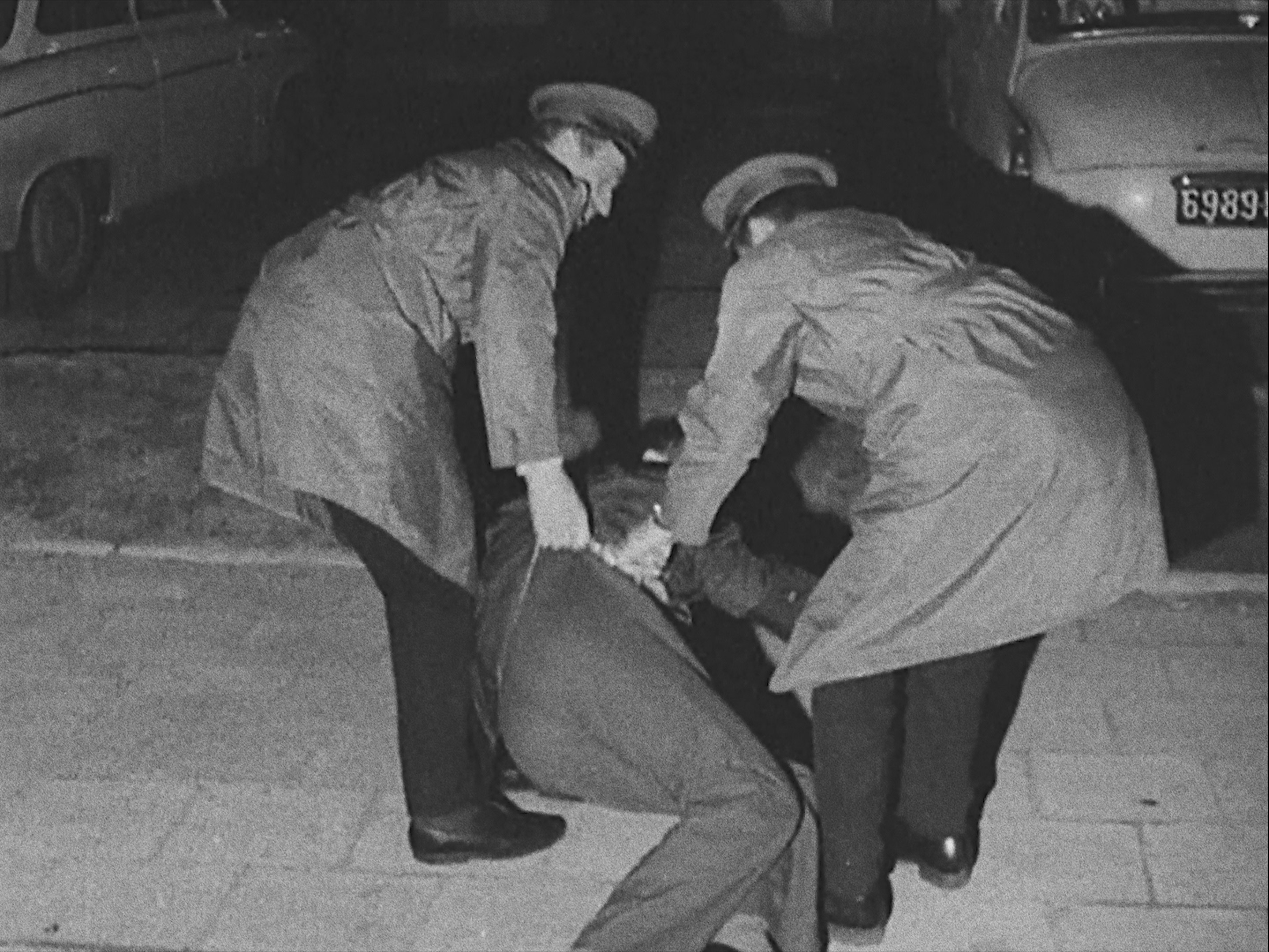
This film is a part of film programme “What We Left Unifinished”, presented on 8-12 December at Skalvija Cinema Center. During this programme that researches archival films, we will move on to personal and public memories.
Curatated by Karolis Žukas.

This film is a part of film programme “What We Left Unifinished”, presented on 8-12 December at Skalvija Cinema Center. During this programme that researches archival films, we will move on to personal and public memories.
Curatated by Karolis Žukas.

These films are a part of film programme “What We Left Unifinished”, presented on 8-12 December at Skalvija Cinema Center. During this programme that researches archival films, we will move on to personal and public memories.
Curated by Karolis Žukas.
This film is a part of film programme “What We Left Unifinished”, presented on 8-12 December at Skalvija Cinema Center. During this programme that researches archival films, we will move on to personal and public memories.
Curated by Karolis Žukas.

This film is a part of film programme “What We Left Unifinished”, presented on 8-12 December at Skalvija Cinema Center. During this programme that researches archival films, we will move on to personal and public memories.
Curated by Karolis Žukas.
This film is a part of film programme “What We Left Unifinished”, presented on 8-12 December at Skalvija Cinema Center. During this programme that researches archival films, we will move on to personal and public memories.
Curated by Karolis Žukas.
Film “What We Left Unfinished” is a part of film programme “What We Left Unifinished“, presented on 8-12 December at Skalvija Cinema Center. During this programme that researches archival films, we will move on to personal and public memories.
Curated by Karolis Žukas.
These films are a part of film programme “What We Left Unifinished“, presented on 8-12 December at Skalvija Cinema Center. During this programme that researches archival films, we will move on to personal and public memories.
Curated by Karolis Žukas.
The architecture of the inner world and its accompanying narratives unfold in the three-part programme (curator Gerda Paliušytė) inspired by Lauren Berlant’s (1957-2021) philosophy and trajectories of thought. Berlant paid particular attention to affect, the plane of intimacy and feelings and its relationship to power structures; to that which can smother, or on the contrary – to disrupt repetition and resist control. Berlant was also highly critical of neoliberalism as an all-encompassing, repressive system, encouraging to search for a commonality that enables creativity and allows to reject normativity, preconceived “knowledge” and trivial system-imposed habits. The festival programme is divided into three interconnected parts and keywords: studying-relearning, desire-love and coming of age. The programme focuses on the ability to feel, observe, learn, love, fantasise and desire in a complex world of overlapping artificial realities and regimes – a world that not only empowers, but can also limit or disappoint.
The architecture of the inner world and its accompanying narratives unfold in the three-part programme (curator Gerda Paliušytė) inspired by Lauren Berlant’s (1957-2021) philosophy and trajectories of thought. Berlant paid particular attention to affect, the plane of intimacy and feelings and its relationship to power structures; to that which can smother, or on the contrary – to disrupt repetition and resist control. Berlant was also highly critical of neoliberalism as an all-encompassing, repressive system, encouraging to search for a commonality that enables creativity and allows to reject normativity, preconceived “knowledge” and trivial system-imposed habits. The festival programme is divided into three interconnected parts and keywords: studying-relearning, desire-love and coming of age. The programme focuses on the ability to feel, observe, learn, love, fantasise and desire in a complex world of overlapping artificial realities and regimes – a world that not only empowers, but can also limit or disappoint.