Videograms’22: Looking at the Eastern Europe Through the Eyes of Others

In 2022, VIDEOGRAMS, a festival of artists’ films and moving images, travels back and forth across the heterogeneous, controversial, and highly diverse region of Eastern Europe and its definitions of identity. As Russia launched an open and brutal military invasion of Ukraine on 24th February, ideas about the sovereignty of our region and its authenticity that stress the need to evaluate, analyze and delve into the historical past and develop critical thinking have complemented to the original anxiety and concern. As it turns out, the nuanced reality of the region remains unknown not only to people who do not live here but also to ourselves. Freedom of thought becomes inconceivable without access to various historical sources and uninhibited documentation of the present, the ability to gather in groups, enjoy and share not only high culture but also the very streets that act as a medium for self-expression and non-conformism.

VIDEOGRAMS offers a poetic and critical look focusing on the cracks and amnesias of collective memory. It raises issues related to becoming a part of collective memory, the individual’s participation, their significance in these processes, and the resulting potential for creativity. This year’s festival program invites a critical discussion about the region’s socialist past and its many-sided heritage. It also looks for ways to advocate for the complexity of phenomena in these antagonistic times and seeks mutual understanding with the help of moving images. Most of the films in this year’s festival examine the Eastern European region as seen from its borderlands, fringes, by its close and far neighbours, or through  the cultural influences of the so-called former West.. At the same time, we invite the audience to perceive Eastern Europe as an integral part of global, all-encompassing economic and sociopolitical systems.
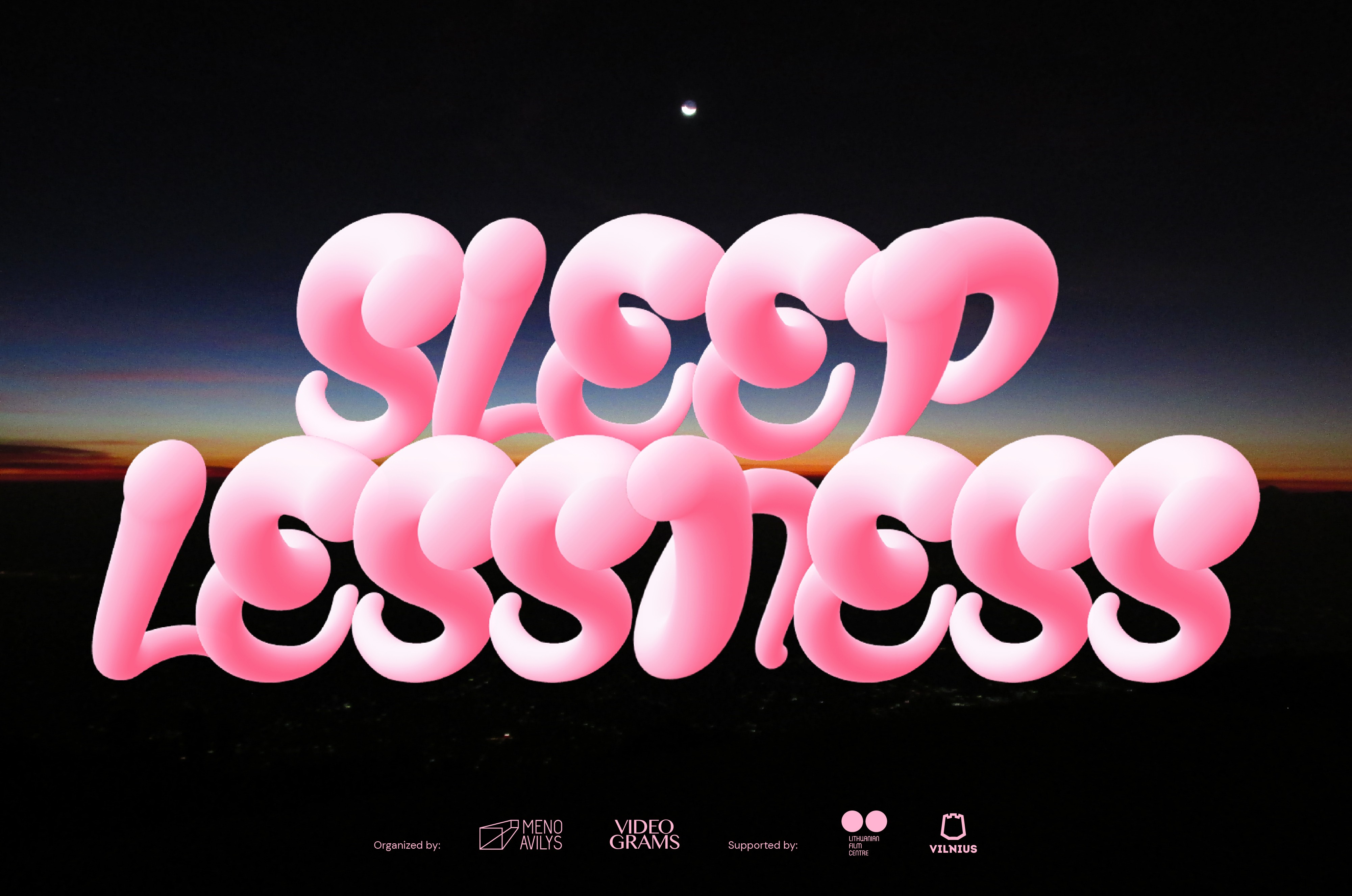
Group exhibition “Sleeplessness”

On 24 November at 7 pm the group exhibition “Sleeplessness” will open artists’ films and moving images festival VIDEOGRAMS’22. The exhibition is displayed in viewing rooms, curated by Meno avilys Cinematheque (corner of A. Goštauto and A. Vienuolio streets, Vilnius). The exhibition “Sleeplessness” is the first part of this year’s VIDEOGRAMS’ edition and will last for all festival dates – until December 11th.

In the exhibition, visitors will see works by artists Tom Kobialka, Peter Wächtler, and Sallamari Rantala, which focus on archaic consumerism and the visual expression of economic systems and how it becomes part of a personal archive. This nighttime story brings together a vampire who spends his days in a castle tower and dreams about a warm blanket, heroes created by the largest Australian bank, which taught children about entrepreneurship, reliefs made of sand, and American marshmallows roasted over a fire.

The curator Gerda Paliušytė crafted the mood of the “Sleeplessness” together with the artist Gediminas G. Akstinas while thinking about an evening at the camping site when the night shadows and the fear they cause become oddly charming and even cozy in a familiar and safe environment.

In 2022, VIDEOGRAMS, a festival of artists’ films and moving images, travels back and forth across the heterogeneous, controversial, and highly diverse region of Eastern Europe and its definitions of identity. In the festival’s program, the Eastern European region is perceived not only as a local narrative or something that thrives in the socialist past but also as a participant in financial capitalism and patriarchy—abstract and surreal economic and social systems that enable each other. This theme is further developed in the exhibition “Sleeplessness”.

The viewing rooms, curated by the Meno Avilys, are located at the uninhabited apartment at A. Goštauto st. 2, the same building as Meno Avilys, its Cinematheque and the Skalvija Cinema Centre.

INFORMATION FOR VISITORS | The exhibition is on display until December 11th, Thursday–Sunday from 4 p.m. to 7 p.m. Before visiting, please call +370 604 76 298 or write gerda.paliusyte@menoavilys.lt.


Organized by Videograms and Meno Avilys
Artists: Tom Kobialka, Sallamari Rantala, Peter Wächtler
Curator: Gerda Paliušytė
Architect: Gediminas G. Akstinas
Graphic designer: Marke Voida
Editor and translator: Aistis Žekevičius
Supported by: Vilnius Municipality, The Lithuanian Film Centre
The activities of Meno Avilys are funded by the Lithuanian Council for Culture

Film “Budinok / Das Haus”

Tatjana Kononenko, Matilda Mester
Germany, 93′, 2019

Presented by Tatjana Kononenko and Monika Lipšic

In Kharkiv in eastern Ukraine stands Derzhprom, the House of State Industry. Built between 1925 and 1928 in the style of constructivism, it intended to embody the idea of communism through its colossal architecture. Although it is one of the biggest realized constructivist buildings and a poster child for the 1920s avant-garde movement, the film, created in 2019, depicts Derzhprom as a time machine, an immovable object with its set system in an otherwise dynamic geopolitical situation. In the context of today’s war, when Kharkiv is one of the most devastated cities in Ukraine, the film speaks yet another language, thus becoming the document of a time of peace in people’s lives in Eastern Europe, a palimpsest in many ways the reading of which will be accompanied by one of the film directors, Tatjana Kononenko. The film premiere took place during the pandemic, so this will be the first and special screening of the director together with the audience.

Tatjana Kononenko was born in Kirovograd, Ukraine, in 1980. She currently lives and works between Berlin and Nicosia. Until 2019 she was enrolled in the film directing program at the German National Film Academy (DFFB) and a fellow of the Elsa Neumann Program of the Berlin Senate for especially promising artists. Tatjana Kononenko has been working with video and photography in projects often dealing with issues of memory and history. Budinok is her first full-length film. Currently, Kononenko is preparing her first feature film, Tales in the Darkness. It is a personal portrait of four generations of women dealing with traces of the traumatic events of 1933 in the present. Tales in the Darkness just received the Wim Wenders Development Prize. 

Matilda Mester was born in Copenhagen, Denmark, in 1980. In 2008 she moved to Berlin to study at the German National Film Academy DFFB. Here, she made her first feature film Limbo (directed by Anna Sofie Hartmann) which premiered at the San Sebastian International Film Festival and was nominated for the Discovery Award at the European Film Awards. Matilda Mester’s work is characterized by an experimental and artistic approach, while Budinok is her first co-directed film. She just had a premiere at CPH:DOX with her first full-length film, Nakskov 1:50.

Film “On A Clear Day You Can See the Revolution From Here”

Emma Charles, Ben Evans James
UK / Kazakhstan, 65′ 2020

The film brings into focus contemporary processes of nation building and myth-making in Kazakhstan through the remnants of Soviet technological infrastructures that haunt the country’s landscape. Shot on 16mm, the camera is drawn across the landscape taking in locations that include mineral mines, the Eurasian Steppe, the STS decommissioned nuclear site and the newly constructed city of Nur-Sultan. “On A Clear Day…” provides a meditative faux observational film about the continual process of construction involved in nationhood and national identity.

Emma Charles is a London-based artist and filmmaker. Working with experimental approaches to moving image and sound, her research based practice navigates the field of non-fiction while engaging with recurring themes of technology, capitalism and landscape. Playing with the blurred lines between documentary and fiction, her work often reveals the artificiality of both the filmic environment and our lived experience.

Ben Evans James is a curator at transmediale festival, Berlin. Co-founder and curator at the artist run centre South Kiosk, London. Researcher and filmmaker at Film is an Architecture. PhD candidate in film curation and exhibition design funded by AHRC. Senior Lecturer at The Bartlett, UCL and Falmouth University. He is based between Europe and Canada.


Work-in-progress presentation with Simona Žemaitytė

This year, at VIDEOGRAMS, we also invite you to meet director Simona Žemaitytė at a very special work-in-progress presentation of her new film. In May 2022, Žemaitytė started filming a many-time national weightlifting champion from Ukraine, who temporarily left his country with his family for Lithuania when the bombing of the Irpin city began. Simona Žemaitytė raises questions about alternative forms of resistance, internal and external struggles, discipline, and masculinity. Today, the hero of the upcoming film has returned to Ukraine, where he continues to train Ukrainian children in a city badly affected by the war and prepares himself for future sports events.

Simona Žemaitytė’s works won awards at the 15th Tallinn Triennal and the Sheffield DocFest. Her films were displayed at the Kaunas Biennal, Oberhausen International Short Film Festival, the Cinémathèque Française, Kasa Gallery and Galata Perform (Istanbul), BAFTA and RichMix (London), CAC, Vartai, Titanikas and Kairė-Dešinė galleries (Vilnius), the “CreArte” exhibition (Pardubice, Linz, and Genoa), Centrala Space (Birmingham). She taught at the Royal Holloway College and the UCL in London. She is currently studying for a Ph.D. in Fine Arts at the Vilnius Academy of Arts (VAA) and teaches at the Department of Sculpture at VAA

Film “Yugoslavia: How Ideology Moved Our Collective Body”

Marta Popivoda
Serbia / France / Germany, 62′ 2013

According to the director of the film, Marta Popivoda, her essay film is a very personal perspective on the history of socialist Yugoslavia, its dramatic end, and its recent transformation into a few democratic nation-states. “Experience of the dissolution of the state, and today’s “wild” capitalist reestablishment of the class system in Serbia are my reasons for going back through the media images and tracing the way one social system changed by performing itself in public space.” Assembling and exploring a vast and rich archive of mediated images of a variety of collective formations in public space in former Yugoslavia, the film deals with the question of how ideology performs itself in public space through mass performances. Marta Popivoda collected and analyzed film and video footage from the period of Yugoslavia (1945 – 2000), focusing on state performances (youth work actions, May Day parades, celebrations of the Youth Day among others) as well as counter-demonstrations (’68, student and civic demonstrations in the ‘90s, 5th October revolution among others). Going back through the images, the film traces how communist ideology was gradually exhausted through the changing relations between the people, ideology, and the state.


Film “5 Dreamers and a Horse”

Vahagn Khachatryan, Aren Malakyan
Armenia / Germany, 82′ 2022

Melania, in her mid-sixties, works as a lift operator in a Yerevan hospital and longs for a late career as a cosmonaut. In a way, she seems to be an anachronistic remnant of the Soviet age. The deep country, still ruled by ancient traditions and ideas of happiness, is represented by the farmer Karen, who is looking for the best of all possible wives. And Amasia and Sona are part of a new generation awaiting the demonstrations and hopes of the revolution. What unites these characters is the dream of a self-determined life – a near-impossibility in a country where the government tries to control everything and everyone.

Vahagn Khachatryan was born in Yerevan, in 1991. He moved to China at the age of 17, and from 2008-2014 studied Filmmaking at the Beijing Film Academy, and started shooting documentaries. From 2014 to 2016 he was part of the DOC Nomads Program, and studied at the ULHT Lusófona University in Portugal, the SZFE University of Theatre and Film Arts in Hungary and the LUCA School of Arts / College Sint Lucas in Belgium.

Aren Malakyan was admitted to the Department of Film Art of Yerevan State Institute of Theatre and Cinema. In 2013, he presented his film “Love Confession in Japanese Style” in Sofia Student Films Festival, Bulgaria, and won in the nomination of Best Film Editing. In 2013, Aren participated in the Polish documentary project “From Sunrise to Sunset” and within the scope of that project he directed the film “Grandpa and Grandma”.


Riedlenčių filmų programa

Peržiūra sudaryta iš pačių riedlentininkų kurtų „skeitų video“, kurie veikia kaip mokymo priemonės ir įkvėpimo šaltiniai bei nuo pat „skeitinimo“ atsiradimo padeda plisti šiai kultūrai visame pasaulyje, įskaitant ir Rytų Europą. Šie video atskleidžia ne tik gyvą ir nuolat kuriamą riedlentininkų santykį su miestų erdvėmis bei taip atveriamas naujas riedlenčių sporto ir pačių erdvių galimybes, bet ir kintančias mados, muzikos bei kinematografijos tendencijas – visa tai, kas yra neatsiejama nuo riedlenčių kultūros.

Visuose peržiūrai atrinktuose video nuotaika kuriama kūrybiškai naudojant įvairias judančių vaizdų kūrimo priemones – efektus, montažą, garso takelį ar siužetą. Keli iš šių kūrinių jau yra tapę pasauline ar vietine žanro klasika: amerikiečio Spike’o Jonze „Video Dienos“ (1991) ar estų Ats Luik ir kt. „Lõuend” (2003). „Lõuend” skamba populiari devinto ir dešimto dešimtmečio estų muzika, o vizualiniai intarpai primena eksperimentinius lo-fi kokybės JAV skeiterių video, kurtus 10 dešimtmečio pradžioje, pavyzdžiui, legendinį riedlenčių kompanijos Alien Workshop video „Memory Screen“ (1991). „Memory Screen“, kuris šiuo metu yra viešai pasiekiamas YouTube paskyroje, yra vienas iš  tų „skeitų video“, kurie dėl savo meninės formos, ilgų su „skeitinimu“ tiesiogiai nesusijusių elementų (situacijų, vaizdo efektų) peržiūrų metu glumino ir kai kuriuos riedlentininkus – tą auditoriją, kuriai šie filmai ir buvo skirti. Estetikos santykis su funkcija, jų tarpusavio ribos ir klausimas, kiek jos sąlygoja „skeitų video“ cirkuliavimą skirtingose industrijų ir kultūros srityse (riedlenčių sporto ir subkultūros, meno pasaulio, kino), buvo pagrindiniai atspirties taškai kuriant ir šią peržiūrą.

Naujesnis estų kūrėjo Antti Sinitsyn video „SPB“ (2018) buvo atrinktas peržiūrai ir dėl savo kinematografijos, ir dėl Vakarų bei sovietinės kultūros ženklų persimaišymo, ir kaip „Lõuend” tąsa. Sauliaus Petrošiaus filmas „One Night” kiek „išmuša“ iš tradicinio „skeitų video“ žanro ir žiūrisi labiau kaip savarankiškas filmas. Taip atsitinka todėl, kad šiame filme už riedlenčių triukus svarbesnis pats pasakojimas ir vasariškos Vilniaus nakties atmosfera. Šią liniją pratęsia ir „Filmas apie Pablo“ (2021), kuriame pagrindinis dėmesys, skirtas įtakingam riedlentininkui Pablo Ramirezui (1993–2019), San Fransisko riedlentininkų bendruomenės nariui, prieš kelerius metus žuvusiam „skeitinimo“ metu. Jo draugo filmų kūrėjo Lucos Balserio sukurtas jautrus trumpanetražis filmas atskleidžia Pablo gyvenimo, kuriame betarpiškai dalyvavo ir „skeitinimas“, džiaugsmą. Pablo Ramirezo (skeiterių bendruomenėje dar žinomo kaip „P-Splifff“) istorija ir visa San Fransisko skeiterių scena garsėja savo beprotiškais triukais stačiomis ir važinėjimui riedlente absoliučiai netinkamomis San Fransisko kalvomis. Iki Pablo ir kitų šio miesto riedlentininkų toks „skeitinimas“ niekada nebuvo praktikuojamas. Pablo ir jo bendraminčių ideologija atskleidžia, kad riedlenčių kultūra ir šiandien gali būti performatyvi, rizikinga bei tampriai suaugusi su urbanistine aplinka.

Seansą pristatys architektė-riedlentininkė Karolina Galvydytė, šiuo metu Žirmūnuose projektuojamo skulptūrų ir riedlenčių parko vadovė.

Film “Holgut”

Liesbeth De Ceulaer
Belgium, 75 min’ 2021

The Siberian permafrost is melting. Ancient bones rise up from the ground and wild animals seem to have disappeared. Three Yakutians venture into the vast wilderness on different quests. Villager Roman and city boy Kyym hunt for a rare reindeer while not so far away, scientist Semyon scourges the permafrost for a viable cell of the mammoth, which he needs to clone the extinct animal. In the midst of an ongoing mass-extinction of fauna and flora, of a Siberian Ivory Rush, and at the dawn of de-extinction, a contemporary myth unfolds. While Roman, Kyym and Semyon close in on their goals, both the frozen earth that they walk on and reality itself melt into another state. Holgut boldly combines elements of fiction and documentary and manoeuvres effortlessly from captivating reality to visual poetry. Down the mammoth-hole, science fiction seems to become reality and reality seems to become myth.

Liesbeth De Ceulaer is a Belgian independent filmmaker based in Brussels, whose films explore the tense and complex relationship between man and his environment. These cinematic explorations lead to captivating worlds, in which documentary and fiction are in continuous exchange.

Film programme “And Europe Will Be Stunned. Trilogy”

by Yael Bartana

And Europe Will Be Stunned is a trilogy by artist Yael Bartana, presented at the Polish Pavilion at the 54th Venice Biennale in 2011. The trilogy is an example of film practice that expands beyond and comes back to the screen, balancing fact, artistic intervention, and fiction, as the three films center around The Jewish Renaissance Movement in Poland (JRMiP), initiated by the artist together with other colleagues, and calling for the 3,300,000 Jews to return to Poland. Today, Bartana’s trilogy seems prescient in the way it tackles the hauntedness of both history and the future.

According to Polish curator and art critic Joanna Mytkowska, “We do not really know whether the Jewish Renaissance Movement in Poland is a genuine party (…) or whether it is a political hallucination. It is in films, after all, that fiction constantly mixes with reality, the living with ghosts, and facts with fables. This is a process akin to the activity of the collective unconscious, where imaginings and fantasies can be forged into actions.” (The Return of the Stranger, 2012)

Yael Bartana (‬born in Israel in ‬1970) employs art as a scalpel inside the mechanisms of power structures and navigates the fine and crackled line between the sociological and the imagination. ‬Over the past twenty years, she has dealt with some of the dark dreams of the collective unconscious and reactivated the collective imagination‭, ‬dissected group identities, and‭ (‬an‭-)‬aesthetic means of persuasion‭. ‬In her films‭, ‬installations‭, ‬photographs‭, ‬staged performances, and public monuments Yael Bartana investigates subjects such as national identity‭, ‬trauma‭, ‬and displacement‭, ‬often through ceremonies‭, ‬memorials‭, ‬public rituals, and collective gatherings‭.‬ Her work has been exhibited worldwide‭ ‬and is represented in the collections of many museums‭, ‬including the Museum of Modern Art‭, ‬New York‭; ‬the Tate Modern‭, ‬London‭; ‬and the Centre Pompidou‭, ‬Paris‭. ‬She currently lives and works in Berlin and Amsterdam‭.

Programme of skaters’ videos

The screening consists of skate videos created by skateboarders themselves, which act as an educational tool and source of inspiration. Since the inception of skateboarding, such videos have helped spread the skateboarding culture throughout the world, including Eastern Europe. These videos reveal not only the lively, constantly developing relationship between skateboarders and urban spaces, which opens new opportunities for skateboarding and the cityscapes themselves, but also the changing trends of fashion, music, and cinematography – everything that is inseparable from this culture.

In all the videos selected for the screening, the mood is invoked by the creative use of various means of producing moving images – effects, montage, soundtrack, or plot. Several of these works have already become global or local classics of the genre: Video Days (1991) by the American director Spike Jonze or Lõuend (2003) by the Estonian director Ats Luik and other filmmakers. Lõuend features popular Estonian music from the 1980s and 1990s, and the visual cutaways remind the experimental, low-fi quality US skater videos of the early 1990s. For instance, the legendary Alien Workshop promotional video Memory Screen (1991). Memory Screen, which is currently available on YouTube, is one of those skate videos that, owing to its artistic form and long sequences of elements not directly related to skateboarding (situations, video effects), confused even some skateboarders during its initial release – the audience for which these films were intended. The relationship between aesthetics and function, the boundaries between them, and the question of how much they determine the circulation of skate videos in different industries and cultural areas (skate sports and skating subculture, the art world, cinema) were the main starting points for the putting together of this screening as well.

The more recent video SPB (2018) by the Estonian artist Antti Sinitsyn was selected for the screening for its cinematography and intermingling of Western and Soviet cultural symbols and as a follow-up to Löwend. Saulius Petrošius’ film One Night somewhat “breaks out” of the traditional “skate video” genre and looks more like a stand-alone film. It happens because, in this film, the story and the atmosphere of a summer night in Vilnius are more significant than skateboarding tricks. This line also is pursued by A Day in the Life of Pablo (2021), which focuses on the influential skateboarder Pablo Ramirez (1993–2019), a member of the San Francisco skateboarding community who died a few years ago while skating. This sensitive short film, created by his friend, filmmaker Luca Balser, reveals the joy of Pablo’s life, in which skating was also directly involved. Pablo Ramirez (aka “P-Splifff” in the skater community) and the entire San Francisco skate scene is famous for their breathtaking stunts on the steep hills of San Francisco, entirely unsuitable for skating. Before Pablo and other skateboarders in this city, this kind of approach was never practiced. The ideology of Pablo and his associates reveals that skateboarding culture today can still be performative, risky, and closely connected with the urban environment.

The screening is presented by the architect-skateboarder Karolina Galvydytė, the manager of a sculpture and skateboard park currently being designed in Žirmūnai.


.